Thursday, May 18, 2017

UNIT 5
Supply-side economics or Reaganomics:
  1. support policies that promote GDP growth by arguing that high marginal tax rates along w/ current system of transfer payments (i.e. unemployment compensation and social security) provide disincentives to work, invest, innovate, and take entrepreneurial adventures
  2. believe AS curve will determine levels of inflation, unemployment, and economics growth

Higher the tax rate you set, less $ you will collect
Laffer Curve is controversial and debatable
Image result for laffer curve

Criticisms:
  1. where economy is located on curve, it is difficult to determine
  2. tax cuts also ↑ demand which can fuel inflation
  3. empirical evidence suggests that impact on tax rates on incentives to work, save, and invest are small

Image result for crowding out macroeconomics Image result for crowding out macroeconomics


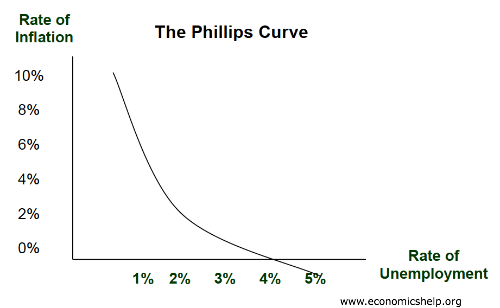
*The Phillips Curve represents the relationship b/t unemployment and inflation
*trade-off b/t unemployment and inflation occurs over SR
*each point on the Phillips Curve corresponds to a different level of output
*LRPC=long run Phillips Curve

  • occurs at NRU
  • represented by ↨ line
  • no trade-off b/t unemployment and inflation in LR
  1. economy produces @ FE output level
  2. nominal wages of workers fully incorporates any changes in PL as wages adjust to inflation over the LR
*LRPC only shifts when LRAS shifts (both have the same determinants)
*↑ in unemployment, LRPC →
*↓ in unemployment, LRPC ←
*Increase in AD=up/left movement along SRPC 

  • C↑, Ig↑, G↑, and/or Xn↑
  • AD→: GDPR↑ and PL ↑; u%↓ and π%↑; up/left along SRPC
  • this would be depicted in the graph below 
*Decrease in AD=down/right along SRPC
  • C↓, Ig↓, G↓, and/or Xn↓
  • AD←: GDPR↓ and PL↓; u%↑ and π%↓; down/right along SRPC
  • in this case, point B would move to point A in the graph below
Image result for phillips curve
Stagflation- persistent high inflation combined with high unemployment and stagnant demand in a country's economy.

Deflation- reduction of the general level of prices in an economy.

Disinflation- reduction in the rate of inflation.


UNIT 7 Image result for absolute advantage


Absolute Advantage
The producer that can produce the most output OR requires the least amount of inputs (resources)
Ex: Papa John has an absolute advantage in pizzas because he can produce 100 and Ronald can only make 20.
Comparative Advantage
The producer with the lowest opportunity cost.
Ex: Ronald has a comparative advantage in burgers because he has a lowest PER UNIT opportunity cost.

Countries should trade if they have a relatively lower opportunity cost.
Balance of trade includes only goods and service but balance of payments considers ALL international transactions.
The balance of payments is a broader measure of international trade.
Details:
The BOP summary is within a given year
Prepared in the domestic countrys currency
Ex. If accounting the BOP of the U.S. it would be in the Dollar.
The balance of payments is made up of two accounts. The  current account and the capital account.

The Current Account is made up of three parts:
1.Trades in Goods and Services (Net Exports)- Difference between a nations exports of goods and services and its imports of goods and services
Ex: Toys imported from China, US cars exported to Mexico 
2.Investment Income- income from the factors of productions including payments made to foreign investors.
Ex: Money earned by Japanese car producers in the US
3.Net Transfers- Money flows from the private or public sectors
Ex: donations, aids and grants, official assistance


The Capital Account measures the purchase and sale of financial assets abroad.
Purchases of things that stay in the foreign country.
Examples: 
US company buys a hotel in Russia
A Korean company sells a factory in Ohio
Dividends earned by Chinese citizens in the New York Stock Exchange (NYSE)
Australian company owns local Mall


The official reserve account, a subdivision of the capital account, is the foreign currency and securities held by the government, usually by its central bank, and is used to balance the payments from year to year.

Tuesday, April 11, 2017


Money and Monetary Policy

The Barter System: goods and services are traded directly. There is no money exchanged. 
Money is anything that is generally accepted in payment for goods and services.
Not the same as wealth or in income 
Wealth- the total collection of assets that store value.
Income is a flow of earnings per unit of time.

3 Functions of Money 
A Medium of Exchange
 • Money can easily be used to buy goods and services with no complications of barter system. 
2. A Unit of Account • Money measures the value of all goods and services. Money acts as a measurement of value. • 1 goat = $50 = 5 chickens OR 1 chicken = $10 
3. A Store of Value • Money allows you to store purchasing power for the future. • Money doesn’t die or spoil. 

3 Types Of Money

Representative Money- Ex- IOUs
Commodity Money-  Salt, Gold, Silver, Cigarettes, something that performs the function of money and has alternative uses.
Fiat Money- Paper money coins. Money because gov't says so.

6 Characteristics of Money

-Durability
-Portability
-Divisible
-Uniformity
-Limited Supply
-Acceptability

3 Types of Money

 Liquidity- ease with which an asset can be accessed and converted into cash (liquidized)
 M1 (High Liquidity) - Coins, Currency, and Checkable deposits (personal and corporate checking accounts). In general, this is the MONEY SUPPLY 
M2 (Medium Liquidity) - M1 plus savings deposits (money market accounts), time deposits (CDs = certificates of deposit), and Mutual Funds below $100K.
 M3 (Low Liquidity) - M2 plus time deposits above $100K.

Purpose of Financial Institutions
A. Save $$
B. Store $$
-savings acct.
-checking acct.
-CD
-Money Market acct.
C. Loan $
Interest- Price paid for the use of borrowed money.
Principal- amount that you borrow

Types of Financial Intermediaries
1. Commercial Bank
2. Savings & Loans Institution 
3. Credit Unions
4. Mutual Funds companies
5. Finance companies

The Financial System
Assets- Anything of monetary value owned by a person or business.
Financial Asset- A paper claim that entitles the buyer to future income from the seller.

Physical Asset- A claim on a tangible object (ex: house, car)

If you go to your bank and take out a loan... the bank has created a financial asset, you have created a liability.

Liability- A requirement to pay money in the future. (usually with interest.

5 major financial assets- loans, stocks, bonds, treasury bonds, and bank deposits.

The Time Value of Money- A dollar is worth more today than it is tomorrow. You are losing money every second you are not investing it.

Real Interest Rate- The intended return on an investment for lending (adjusted for inflation). The true cost of borrowing.

Real- nominal interest rate- expected inflation
Nominal Interest Rates- The rate we get at the bank. The amount of interest that lenders must charge to make a return and adjust for inflation. Nomial= Real i.r + Expected inflation

Future Value- If you invest (or lend) money to someone, it will compound (grow) according to the following equation: FV=PV (1+i)^t

Preent Value- The amount of money I need to invest now, in order to get some amount (FV is known in the futire)

Time value of Money
V= Future value of $
P= Present value of $
r- Real interest rate (nominal rate-inflation rate)
n= years
k=number of times interest is created per year

The Simple Interest Formula 
v=(1+r)^n 

Bonds vs. Stock

Bonds are loans, or IOUs, that represent debt that the government or a corporation must repay to an investor. The bond holder has NO OWNERSHIP of the company.

Stocks are owned

If a corporation sells and issues a bond it is a liability, to the buyer its a asset

If the nominal interest rate decreases the bond increases and vice versa.

Stock owners earn money by: 

Dividends, which are portions of a corporation’s profits, are paid out to stockholders. The higher the corporate profit, the higher the dividend.

A capital gain is earned when a stockholder sells stock for more than he or she paid for it. A stockholder that sells stock at a lower price than the purchase price suffers a capital loss.  

Money Market 

When interest rate increases the Demand for money shows an inverse relationship between nominal interest rates and the quantity of money demanded. Quantity demanded falls because individuals would prefer to have interest earning assets instead
When interest rate decrease quantity demanded increases. There is no incentive to convert cash into interest earning assets

Demand Deposits are made from a fractional reserve system
FRS is the process in which banks keep a portion of their deposits in reserves and loan out the excess.
The money that banks keep on hand is called required reserves.
Banks must keep reserve deposits in their vaut or at their district FEDs (FR bank)

Total Reserves or actual reserves (all the funds in the bank) =RR+FR 

Required Reserves- Cash on hand- vault cash

Excess Reserves- loaned out

Money Creation Formula 
****A single bank can create $ by the amount of its excess reserves. The banking system as a whole can.
 New vs Existing $$
If the initial deposit in a bank comes from the FED or bank purchses of a bond or other money out of circulation (buried treasure), the deposit immediately increases the money supply. 
The deposit then leads to further expansion of the money supply through the money supply through the money creation process total change in MS if initial deposit is new $ < deposit + $ created by banking system

If a deposit in a bank is existing $ existing $ (already counted in M!; ex: currency or checks deposited the amount does not change the MS immediately because it is already counted.

Existing currency deposited into a checking account changes only the composition of the money supply from coins/ paper $ to checking acct. deposits.

Total change in the MS if deposits is existing $= banking system created money only.

If a recession is happening RR should be decreasing
- Banks hold less money and have more ER
-Money Supply increases, interest rate decreases, AD increases, i decreases, 
-Bank creates more money 
Inflation- RR increases
Banks hold more money and have less ER
Banks create less money 
-MS decreases, interest rate increases, AD decreases, i increases

OMO- Price of bonds will increase
**When the FEDS buy or sell bonds 
-If the FED buys bonds , it takes bonds out of the economy and replaces them with money, MS increases
-If it sells- It takes money an gives the security to the investor
Discount rate- The interest rate that the FED charges commercial banks for short term loans.

Federal Fund rate- The interest rate that banks charge one another for overnight loans 
*banks to banks*

Prime Rate- Interest Rate that banks charge their most credit worthy customers 
**ppl with good credit scores

Loanable Funds Market
Private Sector supply and deamand 
**Those who want to lend and borrow 
Demand- Inverse relationship between real interest rate and quantity loans demanded.
Supply- Direct relationship between real interest rate and quantity loans supplied.

Thursday, March 9, 2017

Fiscal policy


Gov't can stabilize the economy by

Fiscal Policy- action by congress to stabilize the economy.

Changes in the expenditures or tax revenues of the federal gov't
.
2 tools
Taxes- gov't cant increase or decrease
Spending- gov't can increase or decrease

FP is enacted to promote por nation's economic goals: full employ., price stability, economic growth.

Deficits, Surpluses, and Debts
Balanced
Revenues= Expenditures
Budget Deficit
Revenues < Expenditures
Budget Surplus
Revenues > Expenditures
Gov't Debt= sum of all deficits- sum of all surpluses


Disposable Income- Income after taxes or net income

DI= Gross Income- Taxes


2 choices w/ DI
Consume or Save

Consumption
Household spending
The ability to consume is contracted by
-the amount of disposable in.
-the propensity to save
Do households consume if DI=0
-Autonomous Consumption
-Dissaving
APC= C/DI that is spent saving

Saving
-Household not spending
-the ability to save is constrained by amount of disposable income
-the propensity to consume
Do households save if DI=0? No

APS =S/ DI= DI that is not spent

APC and APS
APC & APS= 1
1-APC= APS
1-APS=APC

APC >1- Dissaving
-APS: Dissaving

MPS & MPC

-Marginal propensity to consume
change in consumption/ change in disposable income
-% of every extra dollar earned that is spent

-Marginal Propensity to Save
-change in savings/ change in disposable income
-% of every extra dollar earned that is saved
MPC+MPS= 1
1-MPC= MPS
1-MPS= MPC

Determinants
-expectations
-household debt
-taxes


Spending Multiplier Effect
 An initial change in spending causes a larger change in aggregate spending or aggregate demand.

Multiplier= Change in AD/ Change in spending


Expenditures an income flow continuously which sets off a spending increases in the economy.

Spending Multiplier= 1/1-MPC or 1/MPS

Multipliers are pos. w increase of spending and neg. when there is a decrease.


Tax multiplier
- always negative, works in reverse
-MPC/1-MPC or -MPC/MPS

if there is a tax cut then the multiplier is pos.

Reason Prices might be sticky in a downward sloping direction
-menu costs
-price war
-wage contrasts
-minimum wage
-morale, effort, and productivity


Image result for 3 ranges of the aggregate supply curve
What is Investment?
-Money spent or expenditures on:
-New plants (factories)
-Capit. Equipment (machinery)
-Technology(hardware & software)
-New homes
-Inventories(good sold by producers)

Expected Rate of Return
-How does business make investment decisions
-cost/benefits analysis
How does business determine the benefits?
-Expected ratio of return

How does business count the cost?
-Interest costs

How does business determine the amount of investment they undertake?
Compare expected rate of return to interest cost

If expected return> interest cost, then invest
                            < interest cost, then dont

Real (R%) v. Nominal (i%)
Whats the difference?
-Nominal is the observance rate of interest. Real subtracts out inflation (pi%) and is only known as expost facto

How do you compute the real?
r%= i%-pi%

What determines the amount of an investment decision
The real interest rate(%)

Investment Demand Curve (ID)
-Downward sloping

Shifts
-cost of production
-business taxes
-Tech changes
-Stock of capital
-expectations

Aggregate supply
- The level of Real GDP that firms will produce at each price level. (PL)
Long Run- Period of time where input prices are completely flexible and adjust to changes in PL.
The level of real GDP supplied is independent of PL.
Short run- POT. where input are sticky and do not adjust to changes in PL. The level of Real GDP supplied is directly related to the PL.
LRAS- Long run Agg. Supply- marks the level of full employment in the economy (analogous to PPC)
SRAS- Because input prices are sticky in the short run, the SRAS is upward sloping.